Autonomous Walking Rickshaw
Overview
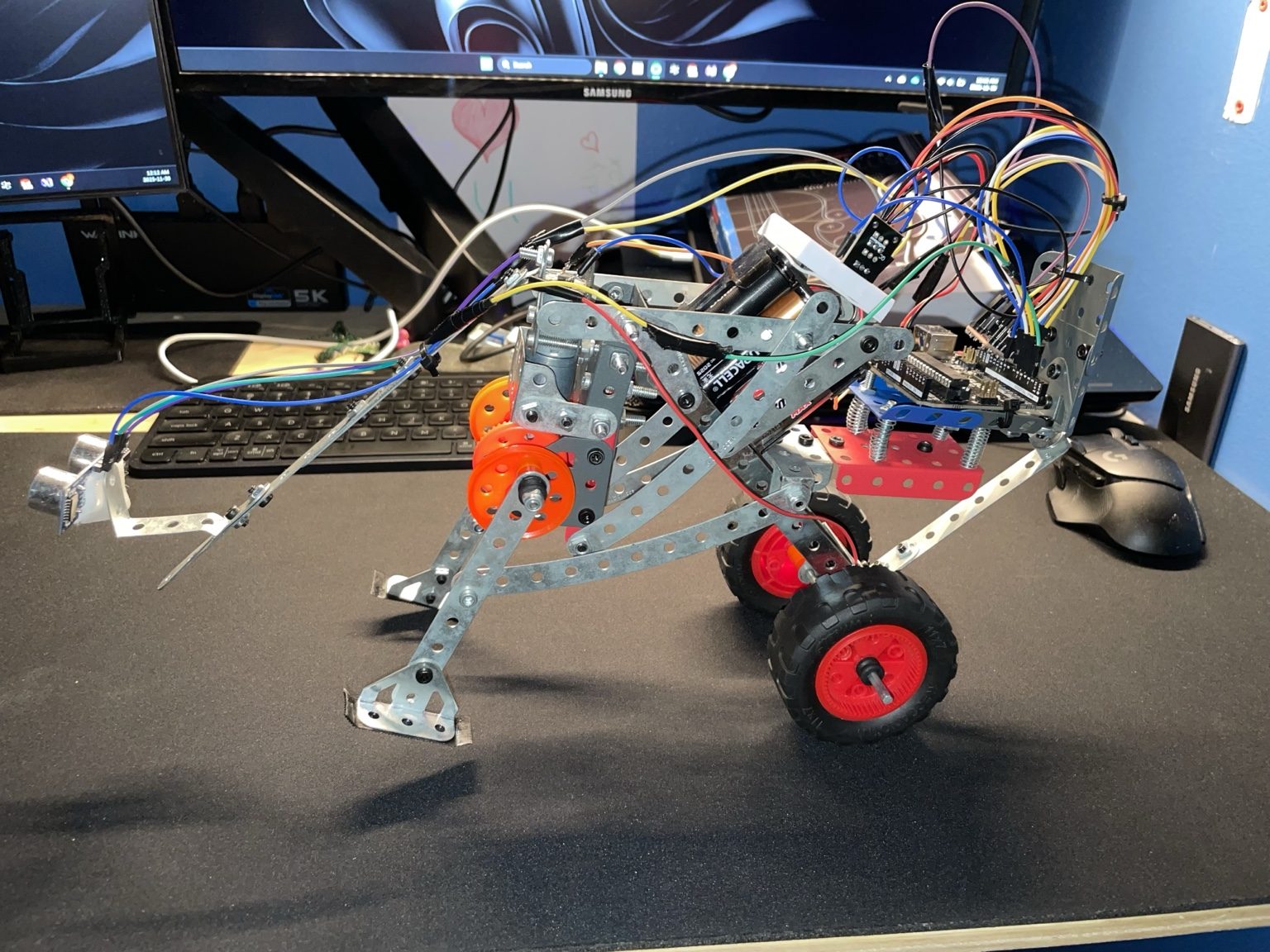
Rickshaws are pulled by a person walking at the front. Our brief was to replace that person with a machine that actually walks: legs instead of wheels, built mostly from Meccano, with under $50 of extra parts and at least one autonomous feature.
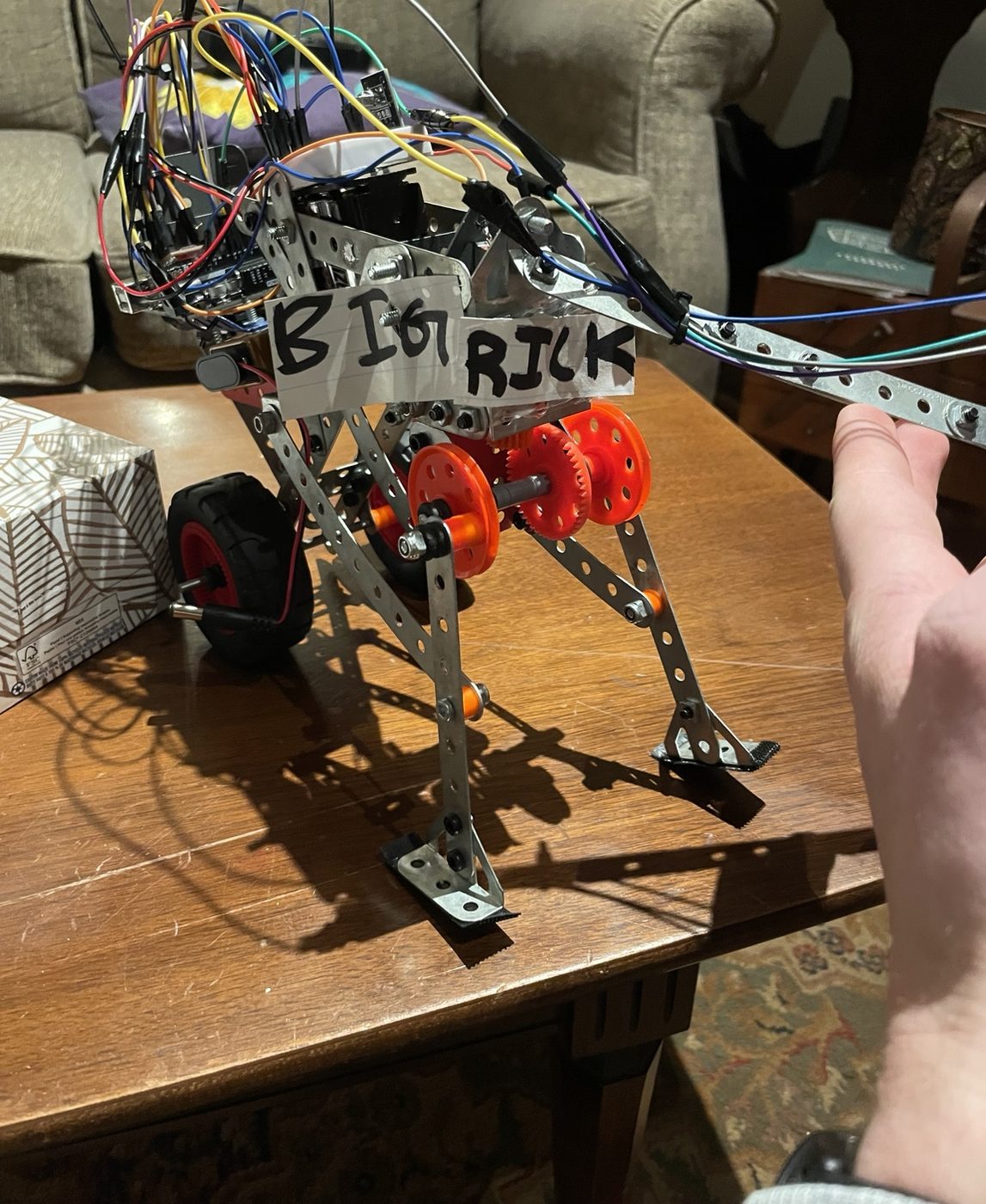
We named it Big Rick. Two crank-rocker legs pull a small two-wheeled carriage, and an ultrasonic sensor lets it stop and back away from obstacles on its own. We designed it in SolidWorks first, then built and tested the Meccano prototype through three rounds of fixes.
My part
I worked on the physical build, the Arduino and sensor programming, and testing, and I presented the chosen design, the issues we found and our fixes, and future improvements.
Choosing the legs
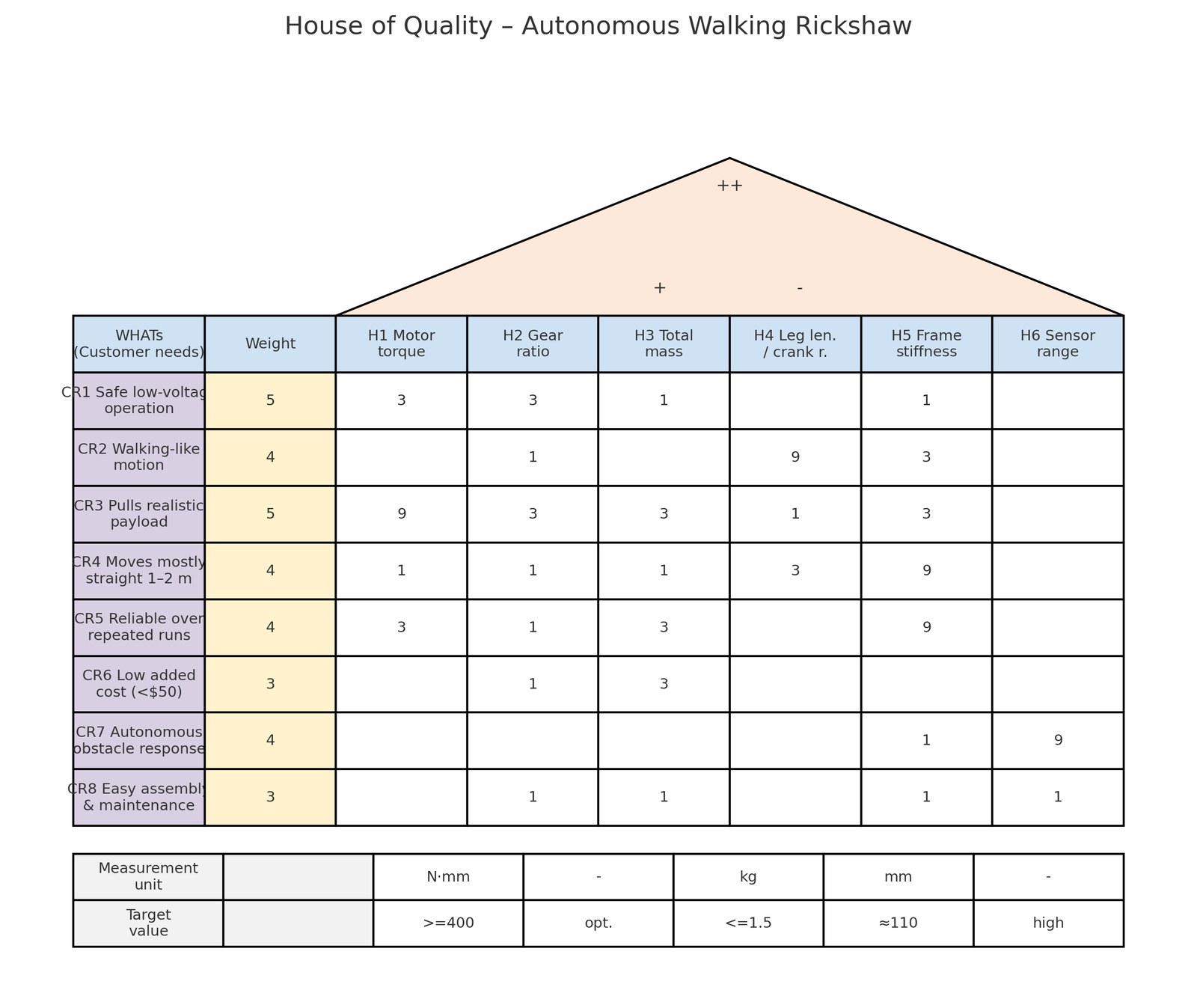
We sketched five walking concepts: Jansen and Klann multi-link walkers, a long-foot biped, a cam-driven sliding foot, and a crank-rocker biped. A weighted decision matrix scored each one on stability, payload, mechanical complexity, how much it looked like walking, and how well it could be built from Meccano.
The crank-rocker won. It's a four-bar linkage on each side, so one rotating shaft makes both feet step. The foot path is set entirely by geometry, which makes the gait repeatable, and the long stance keeps a foot planted while it's pulling. The Jansen linkage walks more realistically, but it was too heavy and complex for the kit.
How it works
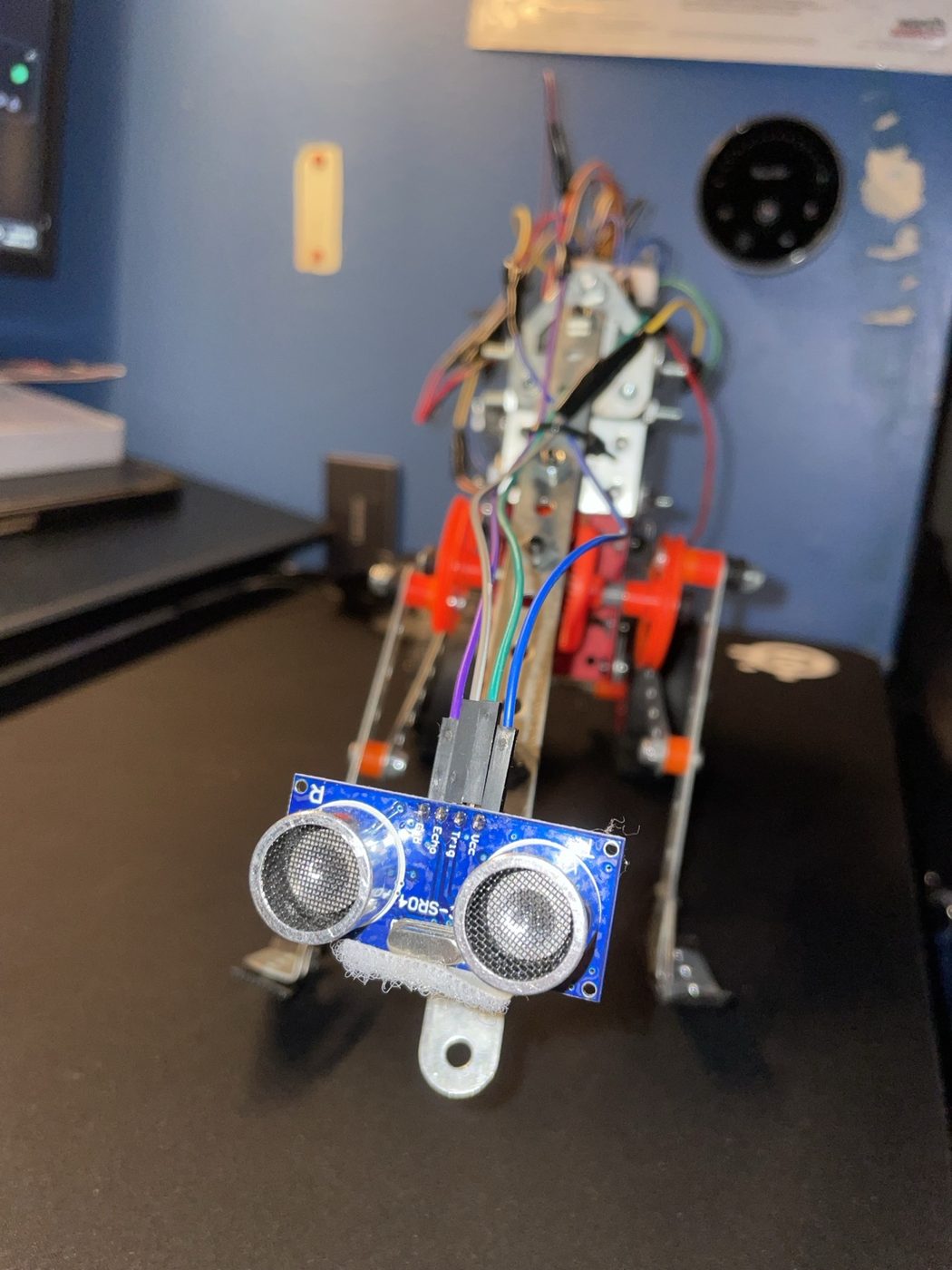
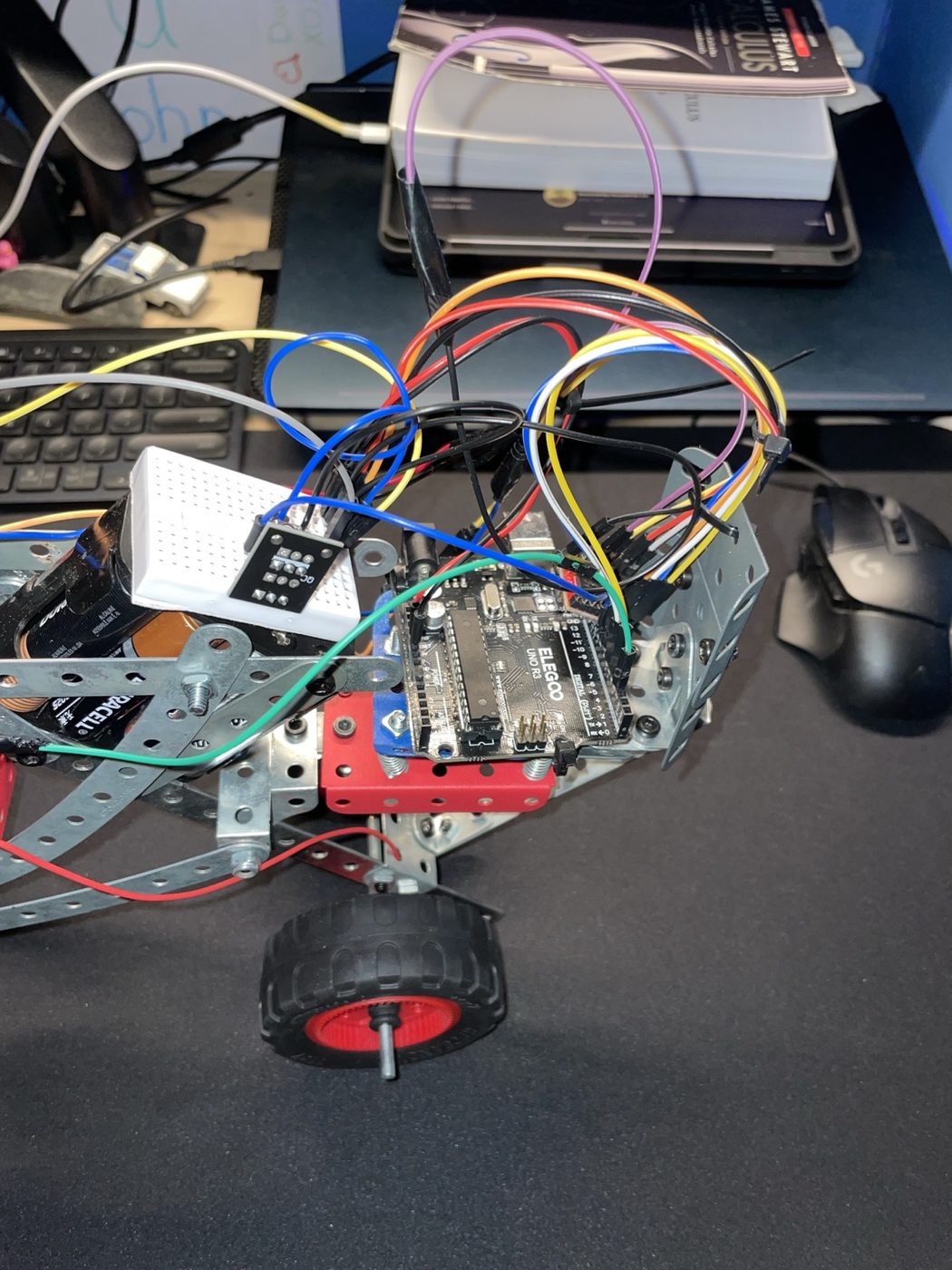
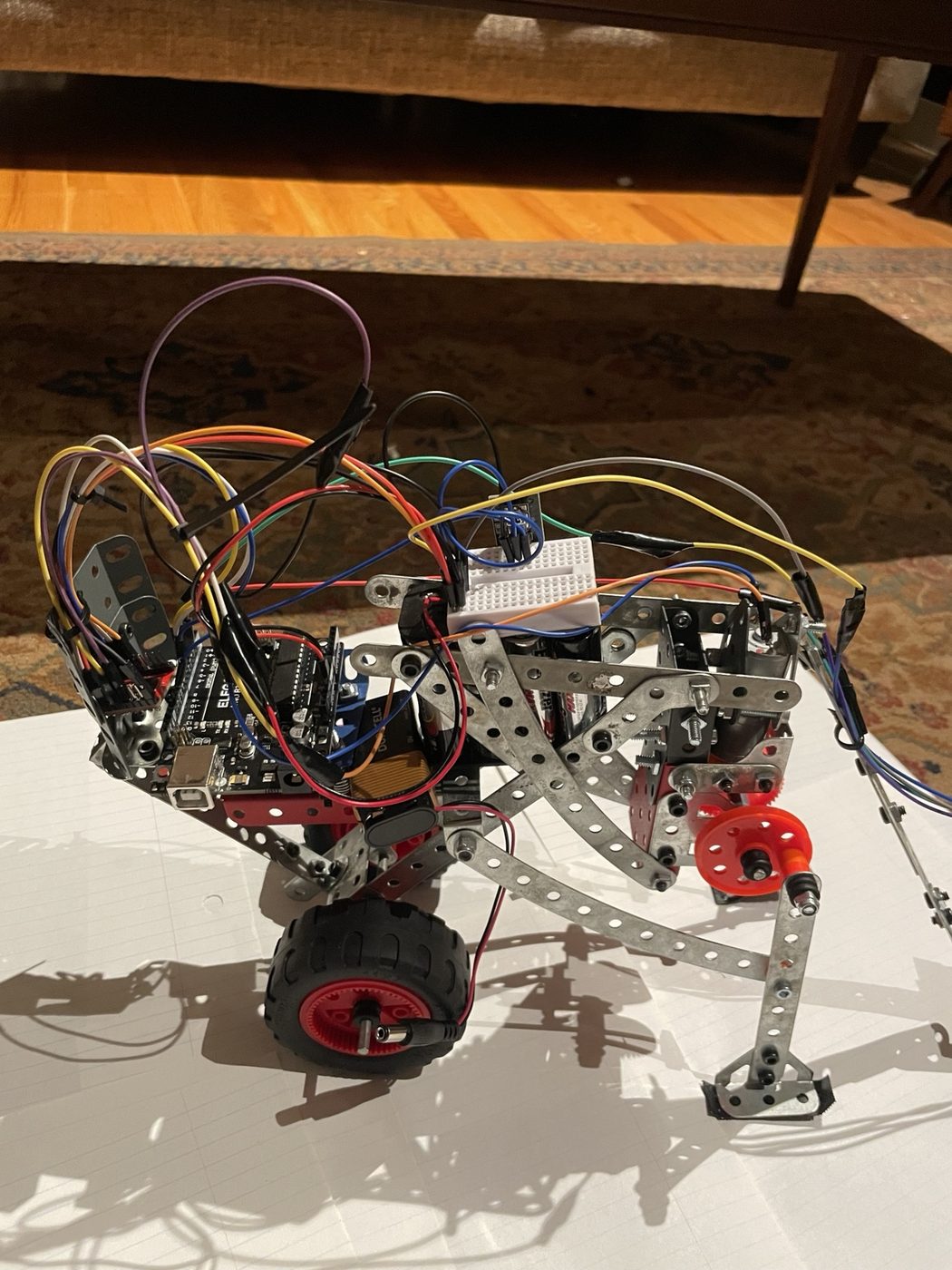
A low-voltage DC motor in the front chassis drives the crank shaft through a spur-gear reduction. An Arduino Uno controls the motor through an L293D driver, reads an HC-SR04 ultrasonic sensor on a boom at the front, and listens for an IR remote that turns the walker on and off.
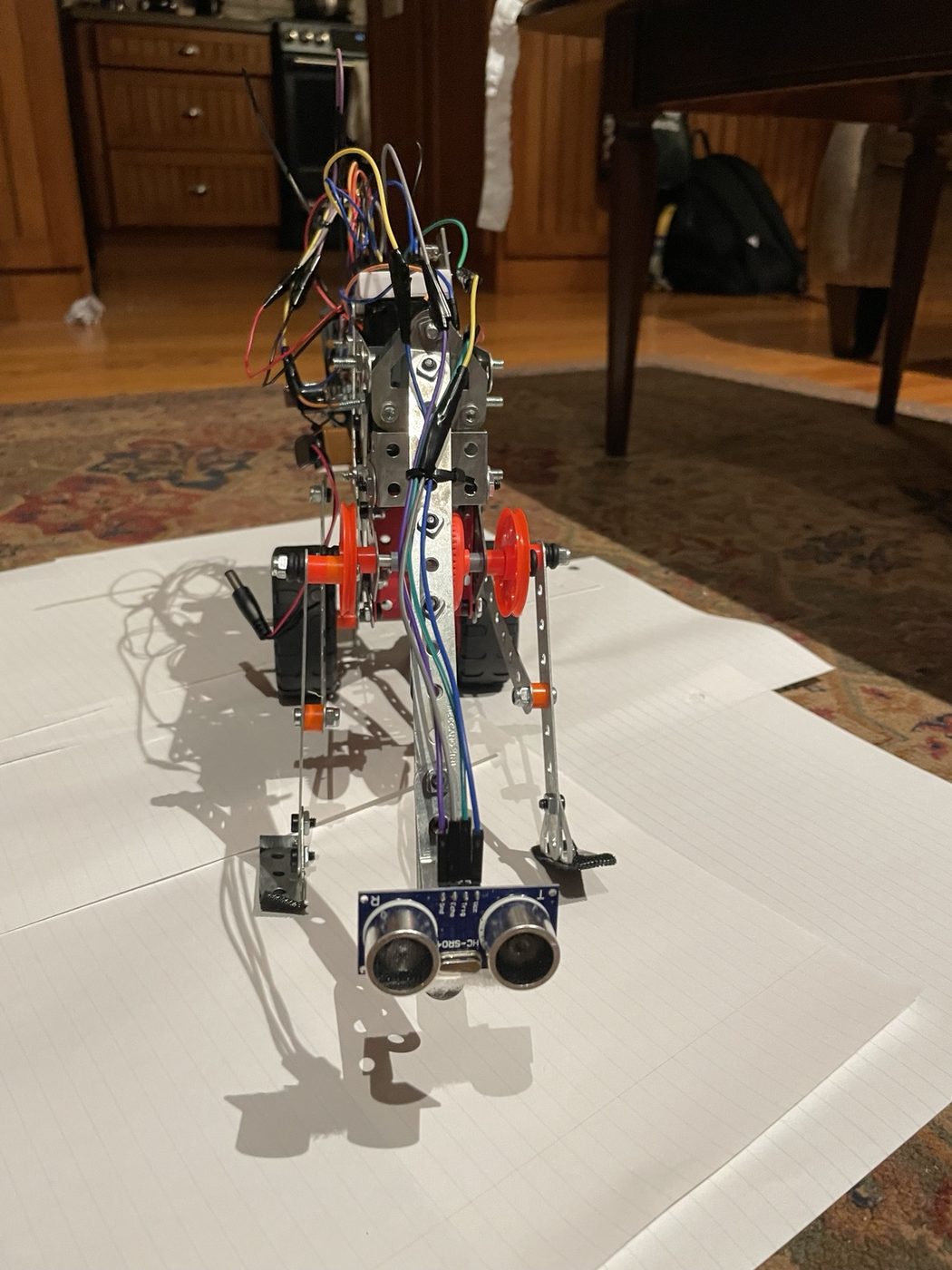
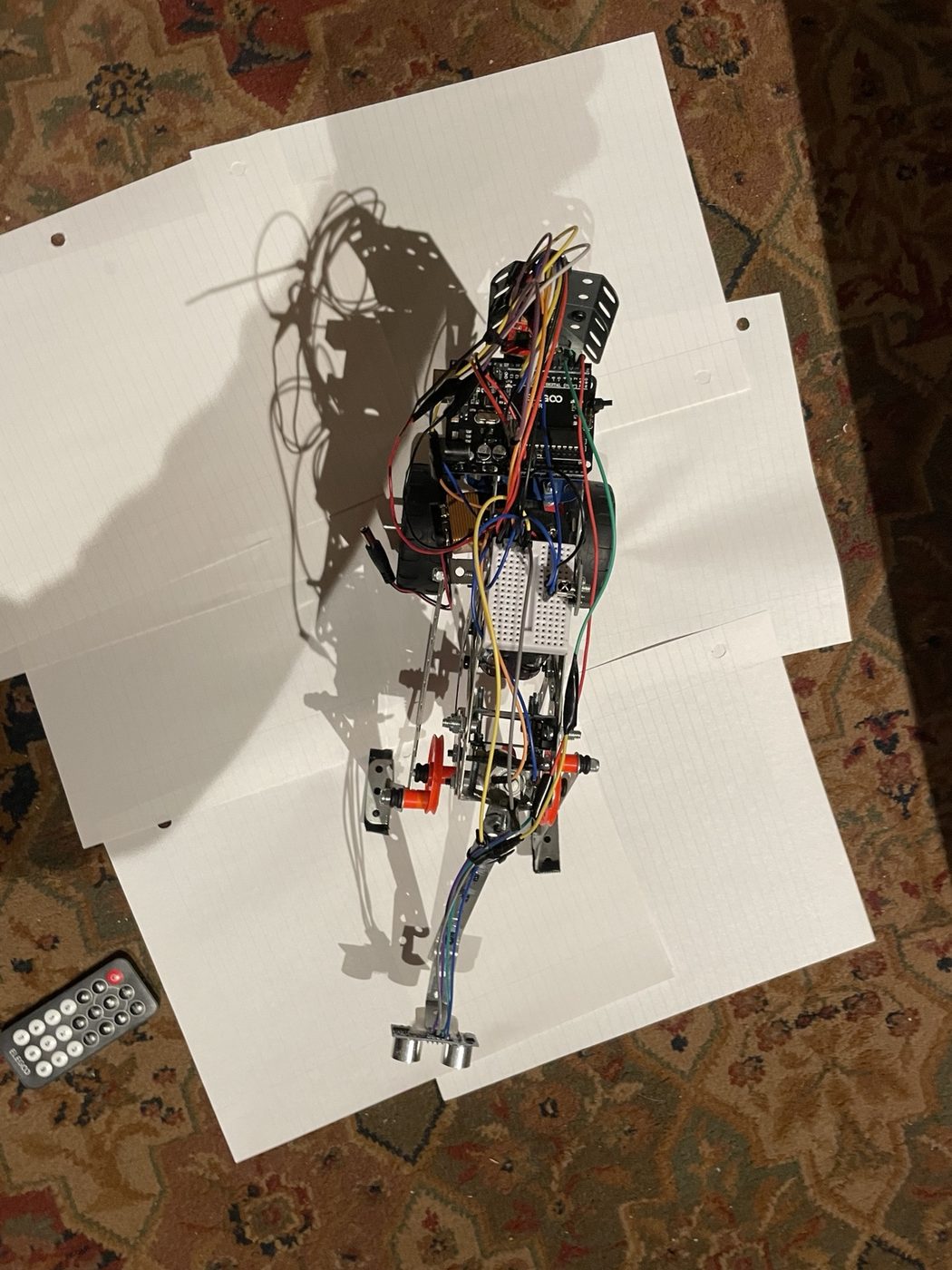
Wiring and control
Ultrasonic readings get noisy when the whole frame is vibrating, so the code doesn't react to a single reading. It averages three pings, smooths them with a moving average, and only treats something as an obstacle after three close readings in a row. Then it runs a simple sequence: stop for 2 s, reverse until the path is clear (up to 5 s), stop for 2 s, and walk forward again.
Testing and fixes
The first test proved the idea worked, and showed everything that didn't: the frame flexed, the gears rubbed, the feet slid and it veered off line. Two more rounds fixed most of it.
- Frame flex: added two diagonal braces and lock nuts at the high-load joints.
- Gear rub: shim washers, better shaft alignment and a little PTFE grease.
- Uneven steps: adjusted the hip pivot and fitted wider rubber feet for traction.
- Noisy sensor: soft-mounted the ultrasonic sensor and filtered its readings.
- Starting under load: a gentler start and tighter joints.
By the final test it started reliably, pulled the carriage and payload, tracked mostly straight, and stopped and backed away from obstacles every time.
What I'd do next
- Try a Jansen or Klann linkage for a flatter foot path and longer stance.
- Add a small servo on the drawbar for steering, plus a friction brake.
- Add a wheel encoder and PID speed control so pace stays steady under load.
- Put a load cell at the hitch to measure pulling force instead of eyeballing it.